

How can people hand over packages comfortably to delivery robots?
People feel more comfortable when robots approach them closely Hideki Tamura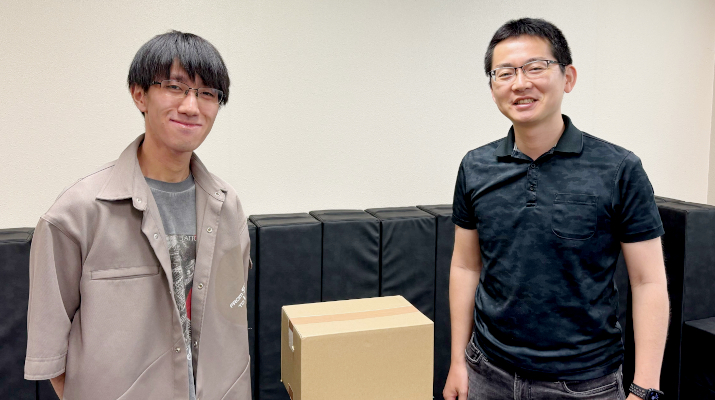
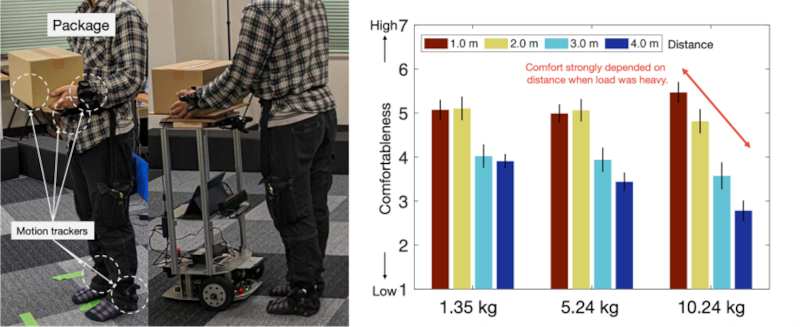
A research team from the Cognitive Neurotechnology Unit and the Visual Perception and Cognition Laboratory, Department of Computer Science and Engineering at Toyohashi University of Technology, investigated human behavior and comfort when handing over a package to an autonomous mobile delivery robot while walking—an interaction envisioned for logistics in future smart cities. The results showed that people tend to feel more comfortable when the robot approaches them more closely, whereas they tend to feel discomfort when the robot stays farther away. This tendency was particularly pronounced when the package being carried was heavy. On the other hand, when the robot came close, participants often slowed down their walking speed and sometimes stopped momentarily, exhibiting brief hesitation. These findings suggest that humans may perceive robots as “helpful partners” rather than mere machines, and that appropriate approach distances and motion designs are essential for achieving comfortable human–robot collaboration.
In recent years, autonomous mobile robots have increasingly been used in logistics and service industries to transport and deliver packages. However, it has not yet been fully understood what distances or movement patterns make people feel comfortable and safe when working in the same space with robots. In particular, when a robot approaches a person to receive a package, its movement trajectory and stopping position may greatly influence how the person perceives comfort and behaves. Against this background, the present study aimed to clarify the behavioral characteristics and subjective comfort of humans when they face and approach an autonomous robot to hand over a package. To achieve this, the researchers conducted three psychophysical experiments.
In the first experiment, the team examined how people’s walking behavior changes depending on how closely the robot approaches. The results showed that when the robot came within a short distance, participants tended to walk more cautiously and often hesitated, sometimes stopping momentarily. In the second experiment, the researchers investigated how the weight of the package influences perceived comfort. They found that participants felt more comfortable when the robot approached closely, especially when the package was heavy. In contrast, when the robot remained stationary at a distance, participants tended to feel uncomfortable. In the final experiment, the study compared people who were familiar with robots with those who were not. No significant differences in comfort ratings were found between the two groups.
Taken together, these findings suggest that humans may perceive a robot’s approach not merely as mechanical motion, but as a cooperative action to help receive the package. In other words, by appropriately designing a robot’s approach distance and motion patterns, it may be possible to create robot behaviors that provide people with a greater sense of comfort and reassurance. This study provides fundamental insights for realizing a society in which humans and robots can collaborate safely and comfortably.
Assistant Professor Hideki Tamura, one of the study’s co-first authors from the Department of Computer Science and Engineering, explained: “Autonomous mobile robots are increasingly being used in various applications such as logistics, food delivery, and serving in restaurants. For these robots to become more familiar and accepted in our daily lives, their movements must be designed to feel natural and comfortable to people. We believe that by incorporating human cognitive and behavioral characteristics into robot motion design, it will be possible to achieve more comfortable coexistence between humans and robots.”
In the future, the research team plans to conduct further investigations in more realistic settings to examine how various factors—such as the robot’s appearance, size, emitted sounds, speed, and direction of movement—affect human perception and comfort. Based on these findings, the researchers aim to establish a foundational framework for designing robot behaviors that enable safe and comfortable collaboration between humans and robots in diverse contexts, including logistics and service environments. These efforts are expected to contribute to the realization of a society in which robots are more naturally accepted as part of our living environments and can work alongside people in everyday life.
Reference
Tamura, H.†*, Konno, T.†, Ito, K.†, Matsubara, Y., Martinsen, M. M., Nakauchi, S., & Minami, T. (2025). Human Behavior and Comfort During Load Carrying to Autonomous Mobile Robot. International Journal of Social Robotics, 1–19. https://doi.org/10.1007/s12369-025-01329-z
(*: Corresponding author, †: These authors contributed equally)
ヒトから運搬ロボットへ快適に荷物を渡すには?
ヒトはロボットに近づいてきてほしい 田村秀希豊橋技術科学大学情報・知能工学系認知神経工学研究室と視覚認知情報学研究室の研究チームは、将来のスマートシティにおける物流を想定し、ヒトが荷物を持って歩きながら自律移動型運搬ロボットへ荷物を渡すときの、ヒトの行動と快適さを調査しました。その結果、ロボットが近くまで来るとヒトは快適に感じやすく、遠いと不快に感じやすいことがわかりました。特に荷物が重いときにその傾向がより強く表れました。一方で、ロボットが近くまで接近するとヒトの歩行速度は低下し、一時的に動きを止めて躊躇する行動も見られました。これらの結果から、ヒトはロボットを「手伝ってくれる存在」として受け止める場合があり、適切な接近距離や動作設計が快適な協働に重要であることが示唆されました。
近年、物流やサービスの現場では、自律移動型ロボットが荷物の運搬や受け渡しを担う場面が増えつつあります。しかし、ヒトとロボットが同じ空間で作業する際に、どのような距離や動き方がヒトにとって快適で安心できるのかは十分に分かっていませんでした。特に、ロボットが荷物を受け取るためにヒトへ近づくような状況では、ロボットの動き方や停止位置がヒトの感じ方や行動に大きく影響する可能性があります。このような背景から、本研究では、ヒトとロボットが向かい合って接近し、ヒトが荷物をロボットに渡す際の行動特性と主観的な快適さを明らかにすることを目的に、心理物理学的手法を用いて3つの実験を行いました。
最初の実験では、ロボットがどの程度近づいたときにヒトの歩行行動が変化するかを調べました。その結果、ロボットが近距離まで接近すると、ヒトは慎重に歩き、一時的に足を止めるなどの躊躇が増える傾向が見られました。次の実験では、荷物の重さが快適さに与える影響を調べました。その結果、荷物が重いときほどロボットが近くまで来た方が快適に感じられ、逆にロボットが遠くにいて動かない場合には不快に感じる傾向がありました。最後の実験では、ロボットに慣れている人とそうでない人を比較しましたが、経験の違いによる行動や快適さの差はほとんど見られませんでした。
これらの結果から、ヒトはロボットの動きを単なる機械的な接近ではなく、「協力して荷物を受け取ってくれる動作」として認識する場合があることが示唆されました。つまり、ロボットの接近距離や動作パターンを適切に設計することで、ヒトに安心感や快適さを与える行動設計が可能であると考えられます。本研究は、ヒトとロボットが安全かつ快適に協働できる社会の実現に向けた基礎的知見を提供するものです。
本研究の共同第一著者である情報・知能工学系の田村秀希助教は「自律移動型ロボットは、近年、都市部での物流、飲食物の配達・配膳など、さまざまな場面で活用が進んでいます。こうしたロボットが今後さらに私たちの身近な存在になるためには、ヒトにより受け入れやすい動き方が求められます。私たちは、ヒトが持つ認知の特性や行動の傾向をロボットの動きに取り入れることで、より快適な共存が可能になるのではないか、と考えています」と述べています。
今後は、現実の利用環境を想定し、ロボットの外観や大きさ、発する音、動く速度や方向などの要素がヒトの感じ方に及ぼす影響をさらに詳しく検証していく予定です。将来的には、こうした知見をもとに、物流やサービスの現場をはじめとしたさまざまな場面で、ヒトとロボットが安全かつ快適に協働できる行動設計の基盤を確立することを目指します。これにより、ロボットが私たちの生活環境の中でより自然に受け入れられ、共に作業する社会の実現につながることが期待されます。
Researcher Profile

| Name | Hideki Tamura |
|---|---|
| Affiliation | Department of Computer Science and Engineering |
| Title | Associate Professor |
| Fields of Research | Kansei informatics / Cognitive science / Vision science / Human-Robot Interaction |
