

Facial expression recognition is modulated by approach-avoidance behavior
Approaching or distancing from others can influence how we perceive their facial expressions Yugo Kobayashi
A research team from the Cognitive Neurotechnology Unit and the Visual Perception and Cognition Laboratory at Toyohashi University of Technology has found that approach–avoidance behavior in a virtual reality (VR) environment modulates how individuals recognize facial expressions. Notably, the study demonstrated that participants were more likely to perceive a facial expression as “angry” when they actively moved away from the face stimulus than when the face moved away from them. These findings contribute to a better understanding of the reciprocal relationship between perception and action in social contexts.
Facial expressions play a fundamental role in social communication. While it is well established that others’ expressions influence our behavior—such as approaching a smiling person or avoiding an angry one—the reverse effect, namely whether our own behavior affects how we recognize others’ expressions, has been less explored.
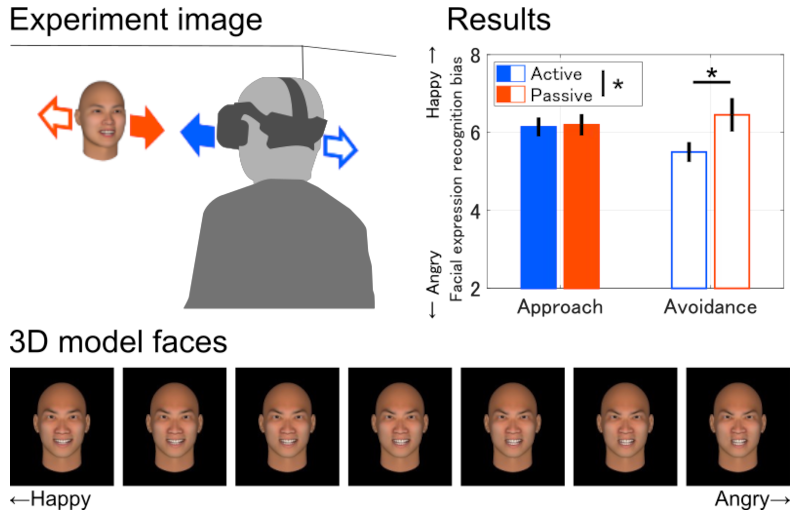
To address this question, the research team conducted three psychophysical experiments using VR. Participants wore a head-mounted display and observed 3D face models (avatars) under four distinct approach–avoidance conditions:
- Active approach: The participant approached the avatar.
- Active avoidance: The participant moved away from the avatar.
- Passive approach: The avatar approached the participant.
- Passive avoidance: The avatar moved away from the participant.
The facial expressions were generated by morphing between happy and angry (or fearful) expressions across seven levels. Participants were instructed to judge each expression as either “happy” or “angry” (or “happy” or “fearful”) depending on the experimental condition.
Results from Experiment 1 showed that participants were more likely to recognize the avatar’s expression as “angry” when they actively avoided the face, compared to when the avatar moved away from them. This suggests that one’s own avoidance behavior may enhance the perception of threat in others’ facial expressions. The pattern supports the hypothesis that behavior and perception are linked in a bidirectional manner.
Yugo Kobayashi, the first author and a doctoral student at the Department of Computer Science and Engineering, commented: “In today’s communication environments such as video conferencing, opportunities for physical movement are limited. These findings suggest that face-to-face communication involving bodily action may facilitate more natural recognition of facial expressions.”
The study provides evidence that one’s own approach–avoidance behavior can modulate facial expression recognition. Future work will examine which aspects of these behaviors—such as motor intention, visual motion, or proprioceptive feedback—are critical to this modulation.
This work was supported by JSPS KAKENHI (Grant Numbers JP21K21315, JP22K17987, JP20H05956, and JP20H04273), the Nitto Foundation, and research funding support for doctoral course students at Toyohashi University of Technology in FY2024.
Reference
Kobayashi, Y*., Tamura, H., Nakauchi, S., & Minami, T. (2025). Facial expression recognition is modulated by approach–avoidance behavior. International Journal of Affective Engineering, Volume 24, Issue 3, Pages 253-266; https://doi.org/10.5057/ijae.IJAE-D-24-00049
*Corresponding author.
表情認知は自身の行動によっても変化する
他者へ近づく・遠ざかることで他者の表情の見え方が変わる 小林優吾豊橋技術科学大学情報・知能工学系認知神経工学研究室と視覚認知情報学研究室の研究チームは、VR(仮想現実)空間内での観察者の対人行動が、他者への表情認知に影響を与えることを明らかにしました。特に、観察者自らが相手から距離をとる行動(回避)をとった場合、相手の表情をより「怒っている」と認知することが分かりました。この研究成果は、コミュニケーションにおける無意識のバイアスを理解する上で重要な知見となります。
私たちは、日常的に他者の表情からその感情を読み取り、それに応じて自身の行動を変化させています。例えば、笑顔の人にはより近づきやすかったり、怒っている人からは距離を置こうとしたりした経験はないでしょうか。このように、他者の表情が私たちの行動に影響を与えることは科学的にもよく知られていましたが、私たち自身の行動が他者への表情認知にどのように影響するのかは、これまで十分に解明されていませんでした。
そこで本研究チームは、この「観察者行動が表情認知に与える影響」を検証するため、VRを用いた3つの心理物理実験を行いました。参加者はヘッドマウントディスプレイを装着し、4つの異なる状況下でVR空間内に表示される3Dモデルの顔(アバターの表情)を観察しました。
- 能動的接近: 参加者自身がアバターに近づく
- 能動的回避: 参加者自身がアバターから離れる
- 受動的接近: アバターが参加者に近づいてくる
- 受動的回避: アバターが参加者から離れていく
アバターの表情は、「幸せ顔」から「怒り顔」まで7段階で連続的に変化させたものを使用し、参加者は各条件下で、アバターの表情が幸せ顔に見えたか、それとも怒り顔に見えたかを応答しました。
実験の結果、参加者が自らアバターを避ける行動(能動的回避)をとった場合に、相手の表情をより強く「怒り」として知覚することがわかりました。この結果は、脅威となりうる対象から距離を置こうとする自己の行動が、相手の表情を「より脅威的(怒り)」であると解釈するバイアスを生じる可能性を示唆しています。
本研究の第一著者である情報・知能工学専攻博士後期課程 3年小林優吾氏は、「今日、ビデオ会議など自身の行動が乏しいコミュニケーション手法が増えましたが、対面での自身の行動を伴うコミュニケーションのほうがより自然に相手の表情を認知できるのかもしれません。」と説明しています。
本研究は、観察者自身の行動により他者への表情認知が変化することを示しました。今後はこの観察者の行動に含まれる、運動した感覚や、視界の変化、自身が動こうとする意志など、どのような要因がこの表情認知の変化に重要なのかを検討していきます。
本研究はJSPS科研費 JP21K21315、JP22K17987、JP20H05956、JP20H04273、公益財団法人日東学術振興財団、豊橋技術科学大学2024年度博士後期課程学生のための研究費支援の助成を受けたものです。
Researcher Profile

| Name | Yugo Kobayashi |
|---|---|
| Affiliation | Department of Computer Science and Engineering |
| Title | Doctor Course Student |
| Fields of Research | Cognitive science / Vision science / Facial expression recognition |