

Digital Service Usage Reshapes Lifestyles and Urban Structure
How Age, Car Ownership, and Online Activities Affect Urban Sustainability Mustafa Mutahari
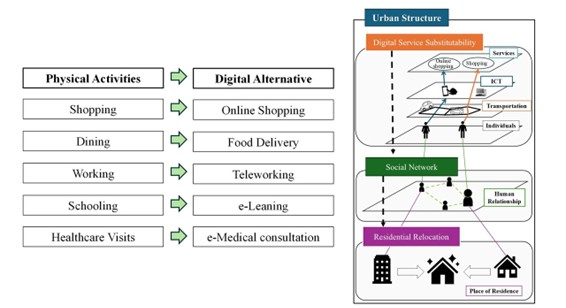
A research team from the Urban and Transportation Systems Laboratory, Department of Architecture and Civil Engineering, Toyohashi University of Technology, conducted research on the impact of digital services alternative usage on equity and sustainability in cities. The study reveals how the use of digital services, such as online shopping and remote work, interacts with social networks and demographics to affect residential location choice and urban structure. The results of this research were published in the international academic journal "Sustainability".
Through a large-scale questionnaire survey of 6,210 individuals nationwide in Japan, the research study investigated how people's digital service usage and their online social interactions affect their residential location choice and urban structure.
The study revealed the following important findings:
- Age matters: Older people use less digital services, and the likelihood of relocating in urban areas decreases by 4.4% for every year they get older.
- Digital service usage and residential location choices: People who use more digital services (e.g., telework, online shopping) are more likely to relocate which can lead to changes in urban structures and demand for public services.
- Car ownership and digital service usage: People who own a car are 9% more likely to shop online than those who do not. Contrary to the common perception that digital services reduce travel, the study found that people who own a car do more online shopping. This may be related to the flexibility of driving to the store to check out products in advance and then purchasing them online at a lower cost.
- Online social networks: People who use more digital services tend to value online relationships such as social media rather than face-to-face relationships, which can affect social cohesion, disaster response, and community-based safety systems. These behavioral changes are not just about convenience, but they are reshaping urban infrastructure, social interaction, and the long-term sustainability of cities.
- Growing digital divide: older people and those living in rural areas are significantly less engaged in digital services, and as online services continue to expand, there is a risk that these groups will be isolated from society.
Mr. Mustafa Mutahari, PhD Candidate, and the main author of the study, stated, “Urban development must be both smart and inclusive. A digitally connected future is only sustainable if it’s equitable and supports diverse populations. Our research is strongly linked to SDG 11 (Sustainable Cities and Communities) and SDG 10 (Reduced Inequalities). Policymakers must balance the provision of digital services and physical services which require mobility. Overdependence on either can harm sustainable urban development. The future lies in integration, not replacement, and this is the path to achieving well-being, inclusion, and urban resilience.
As future research, the research team plans to develop a "quantitative trade-off model" to optimize the balance between digital and physical service usage. This model will quantitatively evaluate the impact of digital service substitution on urban structure, the social environment, and the quality of life of residents, with the aim of contributing to the development of sustainable and inclusive urban strategies.
Reference
Mutahari, M., Suzuki, D., Sugiki, N., & Matsuo, K. (2025). Digital Service Substitution and Social Networks: Implications for Sustainable Urban Development. Sustainability, 17(11), 5185. https://doi.org/10.3390/su17115185
デジタルサービス利用が暮らしと都市構造を変える
年齢・車の保有・オンライン活動が都市の持続可能性に影響 ムタハリ ムスタファ豊橋技術科学大学 建築・都市システム学系 都市・交通システム研究室の研究チームは、デジタルサービスの代替利用による、都市における公平性と持続可能性への影響に関する研究を行いました。本研究では、オンラインショッピングやリモートワークなどのデジタルサービスの利用が、ソーシャルネットワークや人口属性と相互に作用し、住居選択や都市構造にどのように影響を与えているのかを明らかにしています。この研究成果は、国際学術誌「Sustainability」に掲載されました。
全国6,210名を対象とした大規模なアンケート調査を通じて、人々のデジタルサービス利用やオンライン上での社会的交流が居住地選択に与える影響を把握し、都市構造に及ぼす影響を分析しました。
本研究における主要な知見は以下の通りです。
- 年齢の影響:高齢者はデジタルサービスの利用が少なく、年齢が1歳上がるごとに都市部での転居可能性は約4.4%低下します。
- デジタルサービス利用と住居地選択:テレワークやオンラインショッピングなどのデジタルサービスを多く利用する人ほど、転居の意思が強く、都市構造や公的サービス需要にも変化をもたらす可能性があります。
- 自動車保有とデジタルサービス利用:車を所有する人は、所有していない人に比べて9%高い確率でオンラインショッピングを利用しています。デジタルサービスは移動を減らすという一般的なイメージとは異なり、我々の調査では、車を持つ人ほどオンラインで買い物をしていることが分かりました。これは、車で移動して店舗にて商品を事前に確認し、その後オンラインで安価に購入するという柔軟性が関係している可能性があります。
- オンライン上のソーシャルネットワーク:デジタルサービスを多く利用する人は、対面での人間関係よりも、SNSなどのオンライン上での関係性を重視する傾向にあり、社会的結束力や災害対応、地域の安全システムにも影響を与える可能性があります。こうした行動の変化は、単なる利便性の問題ではなく、都市インフラや社会関係、そして都市の長期的な持続可能性そのものを変えつつあります。
- デジタル格差の拡大:高齢者や地方居住者においてはデジタルサービスへの関与が顕著に低く、オンラインサービスが拡大する中で、これらの層が社会から孤立する恐れがあります。
本研究の共同第一著者である博士後期課程3年のムタハリ・ムスタファさんは「都市開発はスマートであると同時に包摂的でなければなりません。デジタルでつながる未来を持続可能なものにするためには、すべての人が公平に参加できることが不可欠です。私たちの研究は、SDGs No.11(住み続けられるまちづくりを)とSDGs No.10(人や国の不平等をなくそう)にも深く関係しています。政策立案者は、デジタルサービスと移動を伴う実空間の店舗等でのサービス提供のバランスを取る必要があります。どちらか一方への依存は、持続可能な都市づくりにとってリスクとなります。今後は『置き換え』ではなく『統合』がカギであり、それがウェルビーイング、包摂性、都市のレジリエンスを実現する道です。」と述べています。
今後、デジタルと実空間でのサービスの利用バランスを最適化するための「定量的トレードオフモデル」の開発を予定しています。このモデルは、デジタルサービスの代替が都市構造、社会環境、そして居住者の生活の質に与える影響を定量的に評価し、持続可能かつ包摂的な都市戦略の立案に貢献することを目指します。
Researcher Profile

| Name | Mustafa Mutahari |
|---|---|
| Affiliation | Department of Architecture and Civil Engineering |
| Title | Doctor Course Student |
| Fields of Research | Urban and Transportation Planning |