

Speed of motor skill acquisition revealed by neural oscillatory activity
Neural activity in the frontal cortex is one of the candidates that determines the motor learning proficiency rate Kazumasa Uehara
A research team consisting of Kazumasa Uehara, Associate Professor in the Department of Computer Science and Engineering at Toyohashi University of Technology, and Yuya Fukuda, a pre-doctoral candidate in the same department, demonstrated that scalp electroencephalogram (EEG) power modulation of 4–8 Hz theta oscillation, known as frontal midline theta (FMT), observed in the medial frontal cortex just before initiating a movement is likely a key neural indicator explaining individual differences in the speed of motor skill acquisition. Analysis of scalp EEG data during a motor learning task integrating vision and motor action revealed that subjects who learned more quickly exhibited higher FMT power just before movement onset. These findings would contribute to the future development of personalized learning support and training methods based on EEG. Such methods could be applied in physical education fields such as rehabilitation and sports training, which require motor learning, as well as in enhancing musical instrument performance skills. The results of this research were published online in Experimental Brain Research on May 15, 2025.
Humans have the ability to flexibly adapt to diverse environmental changes and acquire new motor skills through learning. The speed at which these skills are acquired varies from person to person. Previous studies have reported that EEG theta oscillation in the 4–8 Hz range, known as FMT, observed in the medial frontal cortex before movement onset, increase in power with learning. However, the extent to which FMT power modulation accounts for individual differences in motor learning proficiency rate has remained unclear.
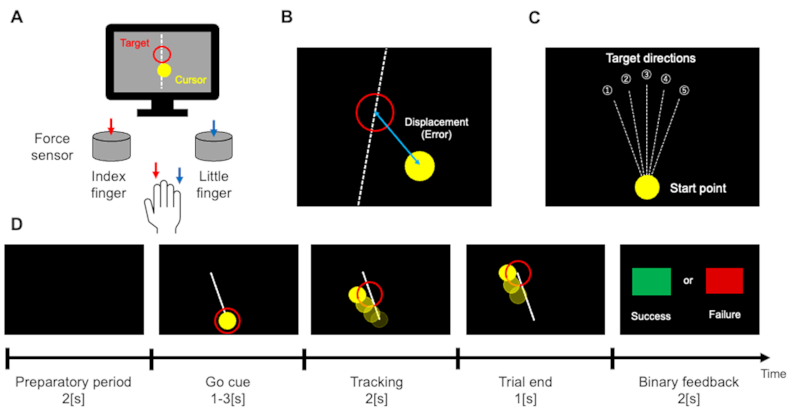
This study aimed to clarify the neural mechanisms underlying individual differences in motor learning proficiency rate by measuring EEG during a visual tracking motor learning task and conducting further analyses. Participants were instructed to follow a target on a computer screen using a cursor (Fig. 1, left). The cursor was controlled by vertically pressing two force sensors, with sensor sensitivity partially altered between sessions. This setup required participants to learn the movement in each session, enabling a quantitative evaluation of the time needed to master a new motor skill (i.e., learning proficiency rate) for each individual.
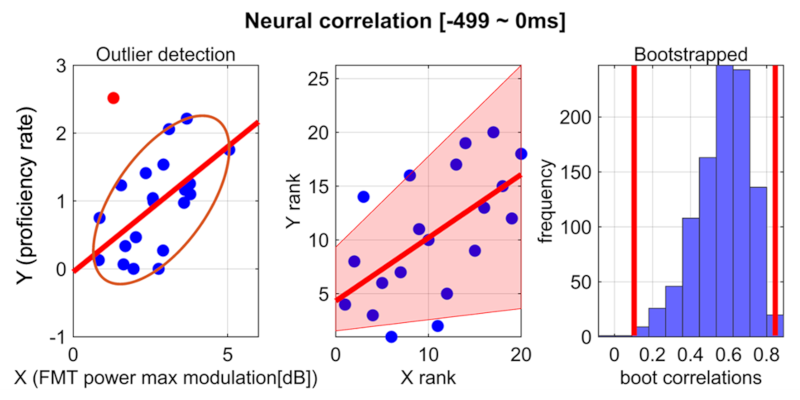
Scalp EEG data recorded during the task were analysed, with a specific focus on the modulation of FMT power prior to movement onset. A neural correlation analysis was also conducted using learning speed indicators. Participants who exhibited greater modulation of FMT power immediately before movement onset adapted more quickly to the new movement pattern. A significant positive correlation was found between FMT power and learning proficiency rate (Fig. 1, right). These findings suggest that increased neural activity in the medial frontal cortex during the preparatory phase prior to movement onset may contribute to more efficient motor learning.
This study demonstrated that FMT power modulation immediately prior to movement onset is significantly correlated with the speed of acquiring a new motor skill. This finding suggests that FMT power may serve as a neural indicator of learning efficiency. Future research will aim to investigate the causal relationship underlying this correlation by employing methods such as neurofeedback and transcranial magnetic stimulation, which can intentionally modulate FMT activity, to further elucidate the underlying mechanisms.
Reference
This study was supported by the Ministry of Education, Culture, Sports, Science and Technology's Grant-in-Aid for Scientific Research (JP19K20103, Uehara) and the Daiko Foundation (Uehara).
https://doi.org/10.1007/s00221-025-07096-7
脳神経活動から紐解く運動技能の習得速度
運動開始直前の前頭野神経活動と運動学習習熟速度の関連 上原一将豊橋技術科学大学 情報・知能工学系の上原 一将 准教授、情報・知能工学専攻 博士前期課程の福田 裕也氏らの研究チームは、運動開始直前に前頭野正中部で観測される4-8Hzのシータ波(Frontal Midline Theta: FMT)のパワー変調が、運動技能の習得速度の個人差を説明する有力な神経指標である可能性を示しました。視覚と運動を統合する運動学習課題中の頭皮脳波を解析した結果、学習が早い被験者ほど、運動開始直前のFMTパワーが高値を示すことが分かりました。本研究成果は、将来的に、運動学習を必要とするリハビリテーションやスポーツトレーニング、楽器演奏技能向上などの身体教育分野において、脳波に基づいた個別最適な学習支援やトレーニング手法の実現につながることが期待されています。本研究成果は、2025年5月15日に「Experimental Brain Research」にオンライン掲載されました。
ヒトは多様な環境変化に対して柔軟に適応し、学習を通じて新たな運動技能を獲得する能力を有しています。こうした技能習得に要する時間(=学習習熟速度)には個人差が見られます。先行研究では、運動開始前に前頭野正中部で観測される4-8Hzのシータ波(Frontal Midline Theta: FMT)が学習に伴いそのパワーを増幅させることが報告されています。しかし、 FMT パワーの変調が学習習熟速度の個人差をどの程度説明するかは未解明でした。
本研究では、こうした個人差の背景にある神経メカニズムを明らかにすることを目的に、視覚追従運動学習課題中の脳波計測を行い、検証を進めました。被験者は、パーソナルコンピュータスクリーン上のターゲットをカーソルで追従する課題に取り組みました(図1左)。カーソルは2つの力覚センサを垂直方向に押すことで操作できるよう設計されており、セッションの切替時にセンサ感度を一部変更することで、運動の再学習を要する状況を構築しました。これにより、各被験者における「新たな運動技能の習得に要する時間(=学習習熟速度)」を定量的に評価可能としました。
課題中に記録した頭皮脳波データを解析し、特に運動開始前のFMTパワーの変調に着目して、学習習熟速度指標との神経相関解析を行いました。その結果、運動開始直前のFMTパワーの変調が大きい被験者ほど、新しい運動パターンへの適応が早期であり、FMTパワーと学習習熟速度との間に有意な正の相関が認められました(図1右)。この結果は、運動開始前の準備状態における前頭野正中領域の神経活動の高まりが、効率的な運動学習に寄与している可能性を示唆しています。
本研究では、運動開始直前のFMTパワー変調が、新たな運動技能の習得速度と有意に相関することを示しました。これは、FMTパワーが学習効率を示す神経指標となり得ることを示唆しています。今後は、この相関関係の背景にある因果性の解明を目指し、FMT活動を意図的に変調させるニューロフィードバックや経頭蓋磁気刺激などの因果検証手法を加え、さらなるメカニズムの解明を行う予定です。
Researcher Profile

| Name | Kazumasa Uehara |
|---|---|
| Affiliation | Department of Computer Science and Engineering |
| Title | Associate Professor |
| Fields of Research | Neuroscience / Neuroengineering |
